

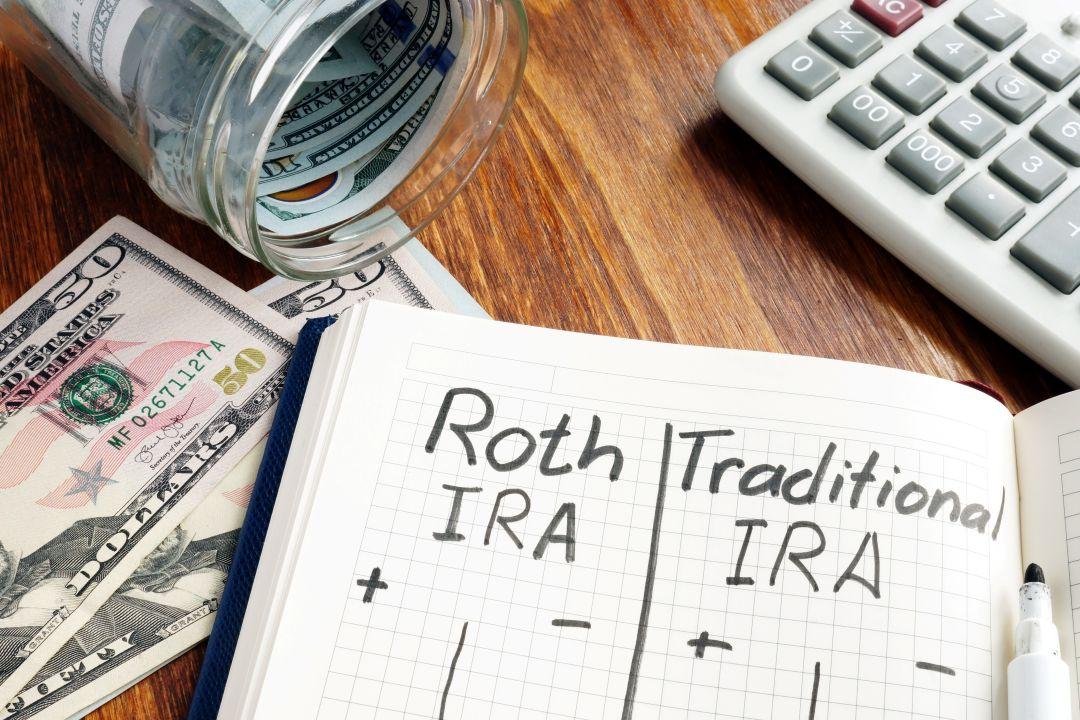
Should You Convert Your Traditional IRA to a Roth IRA in Retirement?
Key Takeaways:
- A Roth conversion moves money you've never paid tax on into an account you won't owe tax on later. The amount you convert is generally added to your taxable income for the year of the conversion. That tax bill is the price of removing those dollars from future taxable withdrawals.
- The years after your paycheck stops and before Social Security and required withdrawals begin can be a comparatively low-income stretch. Converting during those years may cost less in tax than converting after required minimum distributions (RMDs) begin. The size of that difference depends on your own income picture.
- Minnesota retirees weigh two tax bills, not one, plus a few side effects. Minnesota starts from your federal adjusted gross income, so conversion income can raise your state tax as well. It can also reach your Medicare premiums and the taxable share of your Social Security benefits.
Imagine it's the first spring after your last paycheck. You're sitting down to review your income sources, and they look unfamiliar. The wages are gone, and a friend or a financial website has mentioned a Roth conversion. The real question isn't whether it's allowed. It's whether paying tax on purpose, right now, is worth it.
A conversion is a trade: a tax bill you can see today for unknown tax bills you can only estimate later. Whether it helps depends on your whole retirement picture, the main topic of our guide to tax-efficient retirement planning in Minnesota.
What Converting a Traditional IRA to a Roth IRA Involves
In a Roth IRA conversion, you move money from a traditional IRA into a Roth IRA, and the untaxed amount you move is generally added to your income for that year.1 Any part you already paid tax on, such as nondeductible contributions, isn't taxed again.
The IRS describes three ways to do it:
- A 60-day rollover: You receive a distribution from the traditional IRA and deposit it into a Roth IRA within 60 days.1
- A trustee-to-trustee transfer: Your current institution sends the money directly to a Roth IRA at a different institution.1
- A same-trustee transfer: You ask the institution that holds both accounts to move the money between them.1
You report the conversion on Form 8606.1 A conversion made today can't be undone later, because the IRS doesn't allow conversions to be recharacterized.1 If you're still deciding between the two account types, we compare them in our Roth versus traditional IRA article for Minnesota retirees, so this post stays on the conversion question.
Why the Years Before Social Security and Required Withdrawals Begin Matter
For many households, taxable income dips once employment income ends. It can stay low until Social Security benefits begin and required withdrawals push it back up. That dip is the stretch worth examining.
During that gap, your spending usually comes from somewhere else, such as taxable savings or a pension. The first year or two of this transition is covered in our post on what to do 1 to 2 years before you retire. The window is real for some households and barely exists for others, especially with a pension that starts right away or early claiming of Social Security benefits.
Timing also connects to RMDs. Traditional IRA owners generally must begin RMDs at age 73 or 75, depending on birth year.2 Roth IRA original owners have no lifetime RMDs.2
How Minnesota and Federal Taxes Both Apply to a Conversion
Conversion income is taxable on both returns, because Minnesota's income tax starts from federal adjusted gross income.3 Each return has its own rates and rules.
Three layers are worth separating:
- The federal layer: The converted amount is added to your income and taxed at your federal rates. Larger conversions can move income into higher brackets.
- The Minnesota layer: The same amount raises your state taxable income. Minnesota's four rates currently run from 5.35% to 9.85%.4
- The Social Security subtraction: Minnesota lets many retirees subtract some or all of their taxable Social Security benefits. The full subtraction is available below $108,320 of adjusted gross income for joint filers and $84,490 for single filers, then it is reduced by 10% for each $4,000 over.5
That third layer is easy to miss. For a household near its phase-out range, extra conversion income can shrink the subtraction, so the cost isn't only the state rate on the converted dollars. If a move out of Minnesota is on your mind, that changes how you think about timing, and we cover it in whether to stay in Minnesota in retirement.
How Converting Now Changes Future Required Minimum Distributions
Money you convert to a Roth IRA leaves your traditional IRA balance, and that balance is what future required minimum distributions (RMDs) are calculated from. A conversion can therefore reduce those later required withdrawals.2 Original owners of Roth IRAs don’t have lifetime RMDs, so the converted dollars aren’t pulled back into the required-withdrawal formula.2
In practice, this gives you more say over which years carry taxable income. Without conversions, a large traditional IRA can force sizable taxable withdrawals once RMDs begin, whether you need the money. That matters most for a household that expects required withdrawals to be larger than it plans to spend. Converting some of the balance earlier spreads the taxable income across more years, while letting you choose which ones.
Reducing a future RMD isn’t the same as reducing lifetime tax, though. The tax you pay on the conversion now has to be weighed against the tax you might have paid later, and that comparison should still be run with your own numbers.
How Conversion Income Can Raise Medicare Premiums and Social Security Taxes
Two side effects tend to surprise people.
Medicare premiums. Higher-income beneficiaries pay an income-related monthly adjustment amount (IRMAA) on top of their Medicare Part B and prescription drug premiums. The Social Security Administration generally uses your modified adjusted gross income (MAGI) from two years earlier, so a conversion this year can show up in premiums two years from now.6 For 2026, the standard Part B premium is $202.90 a month, and higher premiums begin above $109,000 for single filers and $218,000 for joint filers.7
Taxable Social Security. If you're already collecting benefits, conversion income can raise the taxable portion. Federally, up to 85% of benefits can be taxable once your income passes certain levels.8 That's a second reason the conversion window often looks better before claiming than after.
Deciding How Much to Convert and How to Pay the Tax
How much
Converting an entire IRA in one year can push income through brackets and past thresholds that a series of partial conversions might avoid. For that reason, the question is usually how much to convert this year, not whether to ever convert. Because income, Medicare thresholds, and Minnesota's rules shift each year, this is a multi-year calculation that we model during our tax planning work.
How to pay the tax
You can pay the tax from savings outside the IRA, or you can have tax withheld from the conversion itself. Paying from outside savings keeps the full converted amount inside the Roth IRA. Withholding shrinks what lands in the Roth, and for someone under 59½ the withheld amount may also be treated as an early distribution. It's worth confirming that rule with a tax professional before choosing withholding.
A Hypothetical Partial Conversion for a Minnesota Couple
This example is hypothetical, for illustration only. It uses round numbers and ignores growth, inflation, and individual circumstances. It is not a recommendation or a predicted result.
A Bloomington couple, both retired, haven't started Social Security and are living on taxable savings. They have a traditional IRA and are weighing a partial conversion this year against waiting. Here is the shape of the comparison, using assumed rates of 12% federal and 6.8% Minnesota on the converted amount: a $40,000 conversion adds about $4,800 in federal tax and about $2,720 in Minnesota tax, for roughly $7,520 in total. If they pay that from savings outside the IRA, the trade-off is that those dollars are no longer available to spend or invest elsewhere.
When Converting May Not Make Sense
A conversion is not automatically beneficial. The answer is probably no, or not yet, in situations like these:
- Income is already high this year, so the converted amount would be taxed at higher rates.
- You have no savings outside retirement accounts to pay the tax.
- You'll spend the money within a few years, leaving little time for the tax tradeoff to work.
- You're just under a Medicare or Social Security threshold, and conversion income would push you over.
- Your beneficiaries may face lower tax rates than you do.
Time horizon and estate goals
The case for converting generally strengthens the longer the money can stay invested and the higher the expected tax rate of whoever inherits it. Both are estimates, not facts.
Roth Conversion FAQs
1. Is there an age limit for converting a traditional IRA to a Roth IRA?
The IRS conversion rules don't set a maximum age, and conversions aren't limited by your income.9 If you're subject to RMDs, however, the RMD for the year can't be converted. Take it first, then convert any additional amount.2
2. Do you have to take your required minimum distribution before converting?
Yes, in the years you're required to take one. An RMD can't be rolled over, so it can't be part of the conversion.2
3. Can a Roth conversion be reversed if your situation changes?
No. Conversions made after 2017 can't be recharacterized, meaning you can't undo them later.1 That's why the tax effects are worth reviewing before converting.
4. How does the five-year rule apply to money you convert?
Each conversion generally has its own five-year period for the 10% additional tax on converted amounts withdrawn before age 59½. A separate five-year rule applies to whether Roth earnings come out tax-free. A tax professional can help you track the dates.2
5. How is a conversion reported when you file your taxes?
You report it on Form 8606, Nondeductible IRAs.1 Your IRA custodian also sends tax forms showing the amount converted.
Working Through a Conversion Decision With a Minnesota Planner
At Clerestory Advisors, we help Minnesota households compare the cost of converting now against the taxes they would likely face later. We look at federal and Minnesota taxes, Medicare, Social Security timing, and required withdrawals together instead of one at a time.
If you'd like to talk through whether a conversion fits your situation, we invite you to schedule a call. We'll start with your numbers and your goals.
Resources:
- Internal Revenue Service, "Retirement Plans FAQs Regarding IRAs
- Internal Revenue Service, "Publication 590-B, Distributions from Individual Retirement Arrangements (IRAs)
- Minnesota House Research Department, Social Security and Income Taxes
- Minnesota Department of Revenue, Income Tax Rates and Brackets
- Minnesota Department of Revenue, Social Security Benefit Subtraction
- Social Security Administration, "Medicare Premiums: Rules for Higher-Income Beneficiaries"
- Centers for Medicare & Medicaid Services, "2026 Medicare Parts A & B Premiums and Deductibles,"
- Internal Revenue Service, "Publication 915, Social Security and Equivalent Railroad Retirement Benefits,"
- Internal Revenue Service, "Topic No. 309, Roth IRA Contributions"

Liz Alf
Liz Alf is the Principal of Clerestory Advisors and a fee-only CERTIFIED FINANCIAL PLANNER™ located in Minneapolis, MN. She is a member of the National Association of Personal Financial Advisors (NAPFA), the Fee Only Network, and Wealthtender. Clerestory Advisors is a fee-only financial planning firm in Bloomington, Minnesota, helping couples, independent women, and young professional families across the Twin Cities area of Minneapolis–St. Paul, prepare for retirement.