

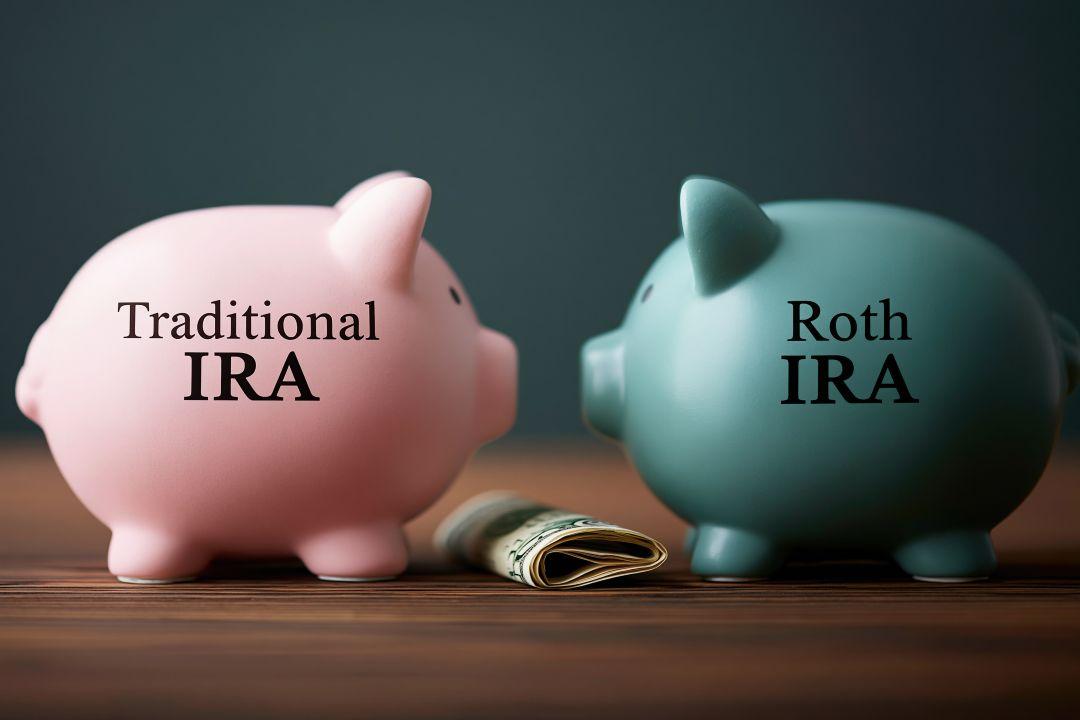
Roth IRA vs. Traditional IRA in Minnesota: Which Is Better for Retirees?
Key Takeaways:
- The difference is when you pay tax, not how much the account earns. A traditional individual retirement account (IRA) is generally taxed when you take money out. A Roth IRA is taxed when you put money in.
- Minnesota adds a second layer to the comparison. Your IRA withdrawals can show up on both your federal and Minnesota returns, and they can also affect how much of your Social Security is taxed.
- Having both account types gives you choices in a given year. Each account leaves a different mark on your income, and that can give you room to adjust.
Picture your latest account statement. There are two lines on it: a traditional IRA and a Roth IRA. One balance has never been taxed. The other already has been. Both look like savings, but they behave very differently once you start spending them.
This post sorts out how each account is taxed, what Minnesota adds, and how withdrawals can ripple into Social Security and Medicare. If you want the wider picture first, our guide to tax-efficient retirement planning in Minnesota covers how the pieces fit together.
How Roth And Traditional IRAs Are Taxed Differently
The short answer is that neither account comes out ahead in every situation. The two accounts tax you at opposite ends and the one that works harder for you depends on which year your tax rate is higher.
- Traditional IRA: Contributions may be deductible, depending on your income and whether a workplace plan covers you. Withdrawals are generally taxed as ordinary income.1
- Roth IRA: Contributions are made with money you've already paid tax on. Qualified withdrawals are not taxed. For a Roth, these generally require that the account has been open for five tax years and that you are at least 59½, or meet another exception listed by the IRS.1
If you're still working, even part time, you can keep contributing to either account. The IRS sets no age limit for contributions, though you need earned income.2 For 2026, the contribution limit is $7,500, plus $1,100 if you're 50 or older.3 Roth contributions begin to phase out at higher incomes, and traditional deductions can phase out if a workplace plan covers you.3
What Minnesota's Income Tax Adds To The Comparison
Federal tax is only half of the story for Minnesotans. Minnesota has its own income tax with four rates, currently ranging from 5.35% to 9.85%.4
That matters because a traditional IRA withdrawal generally counts as income on your Minnesota return, too. It's one amount of income reported on both the Federal and state return, each with their own rules. This means that a withdrawal from a traditional IRA costs more in taxes for a Minnesota household. A qualified Roth withdrawal is generally left out of the income on both returns.
Minnesota also handles Social Security differently from many states, which we cover below. Because the state's rules and rates can change, it's worth checking the current numbers each year before you act.
Deciding Whether Your Tax Rate Drops In Retirement
A common rule of thumb says to choose traditional IRA contributions if your tax rate will fall in retirement, and Roth contributions if it will rise. The trouble is that retirement income is harder to predict than it looks. Several things can push your rate up later in life:
- Social Security: Benefits can become partly taxable once your other income rises.
- Pension income: A pension adds to your taxable income every year.
- Required minimum distributions (RMDs): These force taxable withdrawals from traditional accounts, whether or not you need the money.
- Filing status: When one spouse passes away, the survivor typically moves from joint to single tax brackets. The same income can then land in a higher bracket.
Working through those pieces together is a big part of tax planning, because the answer depends on your whole income picture rather than a single rule.
Required Minimum Distributions And The Income They Force
Traditional IRAs come with a deadline. You generally must start taking RMDs at age 73 or 75, depending on the year you were born. Your first one is due by April 1 of the year after you reach that age.5
A Roth IRA works differently. If you're the original owner, you don't have to take distributions during your lifetime, regardless of your age.6
Roth beneficiaries are a separate case. People who inherit a Roth IRA may have to take distributions under the beneficiary rules.6
How IRA Withdrawals Touch Social Security And Medicare
Your IRA withdrawals can reach further than a line on your tax return. Two places show up often for retirees.
Social Security. The IRS looks at your other income plus half of your benefits to decide how much of your Social Security is taxable. Up to 85% of benefits can be taxed at the federal level.7 Minnesota starts from the federal result, then offers a subtraction that phases out as income rises. As of the Department of Revenue's current guidance, the full subtraction is available below $108,320 of adjusted gross income for joint filers and $84,490 for single filers, then it phases out.8 We explain the details in our post on how Social Security benefits are taxed in Minnesota. This means that IRA withdrawals may increase the amount of your Social Security benefit subject to tax.
Medicare. Higher income can lead to an Income-Related Monthly Adjustment Amount (IRMAA), an extra charge added to your Medicare Part B and Part D premiums. It is based on your modified adjusted gross income from two years earlier.9 For 2026, the standard Part B premium is $202.90 a month. Extra charges begin above $109,000 for single filers and $218,000 for joint filers.10 Therefore, IRA withdrawals may end up increasing your Medicare premiums.
A Roth withdrawal doesn't count toward these measures the way a traditional withdrawal does. That's one reason the mix of accounts matters.
Two Twin Cities Retirees, Two Different Answers
This example is hypothetical, for illustration only. It uses round numbers and ignores investment growth, other taxes, and inflation.
Dan, a retired teacher in St. Paul. Dan has a pension and Social Security that cover most of his spending. He needs about $10,000 a year from his IRA. Because his other income is already steady, extra taxable withdrawals could move more of his Social Security into the taxable column. A Roth balance could give him a way to take some income without adding to that total.
Maria, a retired nurse in Edina. Maria has modest income outside her IRA in a year when she's spending less. She plans to delay Social Security. In a lower-income year like this one, taking some money from her traditional IRA may fit comfortably into a lower bracket.
Same types of accounts, different circumstances, different answers. Which decision will be best for you depends on your own income and asset profile.
Why Having Both Accounts Gives You Choices
When you hold both, you can decide each year how much taxable income to show. In a year with large medical bills, you might lean on the traditional account. In a year when you want to stay under a Medicare threshold, you might use the Roth.
That flexibility is hard to build once you're already retired, which is why many people review their account mix before major changes. Our financial planning for retirees work looks at how these accounts fit alongside your income, spending, and legacy goals.
What each account leaves behind. Heirs who inherit a traditional IRA generally pay income tax on withdrawals. Heirs who inherit a Roth IRA may take distributions that are not taxed if the rules are met, though most beneficiaries still face a distribution timeline.6 Conversions between the two account types are also possible, but they involve their own tax rules and should be reviewed one at a time.
Roth IRA vs. Traditional IRA FAQs
1. Can I still contribute to an IRA after I retire?
You can contribute at any age as long as you have earned income, such as wages or self-employment income.2 If you're fully retired with no earned income, you generally can't contribute. Income limits may also affect Roth contributions and traditional deductions.3
2. How does the five-year rule affect Roth withdrawals?
A Roth withdrawal is generally qualified when the account has been open for five tax years and you are 59½ or older or meet another IRS exception.1 Withdrawals that don't meet both tests may be partly taxable. Your account custodian and tax professional can help you confirm your start date.
3. What happens to my IRAs if I leave Minnesota in retirement?
Your IRAs stay yours, but the state you live in decides how they're taxed at the state level. Some states don't tax IRA withdrawals, and others do. It's worth running the numbers before a move. Our post on whether to stay in Minnesota in retirement walks through the larger picture.
4. Does a Roth IRA help my children more than a traditional IRA?
It can, depending on their tax situation. Heirs generally owe tax on traditional IRA withdrawals, while qualified Roth withdrawals are generally not taxed. Most beneficiaries must still empty the account within a set timeline.6 The better fit depends on your heirs' income and your own plans.
Getting Clear On Which IRA Fits Your Retirement
At Clerestory Advisors, we help Minnesota households look at their IRAs alongside their Social Security, pension, taxes, and spending. We use your actual numbers to see how each account may affect your income picture from year to year.
If you'd like to talk it through, we invite you to schedule a call. We'll start with your situation and go from there.
Resources:
- Internal Revenue Service, "Publication 590-B, Distributions from Individual Retirement Arrangements (IRAs)," https://www.irs.gov/publications/p590b
- Internal Revenue Service, "Publication 590-A, Contributions to Individual Retirement Arrangements (IRAs)," https://www.irs.gov/pub/irs-pdf/p590a.pdf
- Internal Revenue Service, "401(k) limit increases to $24,500 for 2026, IRA limit increases to $7,500," https://www.irs.gov/newsroom/401k-limit-increases-to-24500-for-2026-ira-limit-increases-to-7500
- Minnesota Department of Revenue, Income Tax Rates and Brackets, https://www.revenue.state.mn.us/minnesota-income-tax-rates-and-brackets
- Internal Revenue Service, Retirement Plan and IRA Required Minimum Distributions FAQs, https://www.irs.gov/retirement-plans/retirement-plan-and-ira-required-minimum-distributions-faqs
- Internal Revenue Service, "Publication 590-B, Distributions from Individual Retirement Arrangements (IRAs)," Roth IRA and beneficiary rules, https://www.irs.gov/publications/p590b
- Internal Revenue Service, IRS Reminds Taxpayers Their Social Security Benefits May Be Taxable, https://www.irs.gov/newsroom/irs-reminds-taxpayers-their-social-security-benefits-may-be-taxable
- Minnesota Department of Revenue, Social Security Benefit Subtraction, https://www.revenue.state.mn.us/social-security-benefit-subtraction
- Social Security Administration, Benefits Planner: Medicare Premiums, https://www.ssa.gov/benefits/medicare/medicare-premiums.html
- Centers for Medicare & Medicaid Services, "2026 Medicare Parts A & B Premiums and Deductibles," https://www.cms.gov/newsroom/fact-sheets/2026-medicare-parts-b-premiums-deductibles

Liz Alf
Liz Alf is the Principal of Clerestory Advisors and a fee-only CERTIFIED FINANCIAL PLANNER™ located in Minneapolis, MN. She is a member of the National Association of Personal Financial Advisors (NAPFA), the Fee Only Network, and Wealthtender. Clerestory Advisors is a fee-only financial planning firm in Bloomington, Minnesota, helping couples, independent women, and young professional families across the Twin Cities area of Minneapolis–St. Paul, prepare for retirement.